

Anyone who has torn down an old shed or stripped a barn roof knows the moment. The pile in the yard looks manageable, the container looks big enough, and then the scale ticket comes back heavier than expected.
Debris is sold and hauled by volume but weighed and disposed of by weight, and the two don’t move together. A cubic yard of one material can weigh five times as much as a cubic yard of another. For property owners in rural parts of Tangipahoa Parish, where barns, equipment sheds, and older farmhouses are common, that gap shapes how a cleanup gets planned.
Loranger is a good example of the setting. The unincorporated community sits north of Hammond at the junction of LA 40 and LA 1062, and its schools serve families spread across a very rural area. Tear-outs there often involve roofing, framing, fencing, and concrete, which cover the full range of debris weights.
What the federal conversion factors show
The U.S. Environmental Protection Agency publishes standard factors for converting waste volume to weight. Its Volume-to-Weight Conversion Factors for Solid Waste, updated in April 2016, lists construction and demolition materials by the cubic yard.
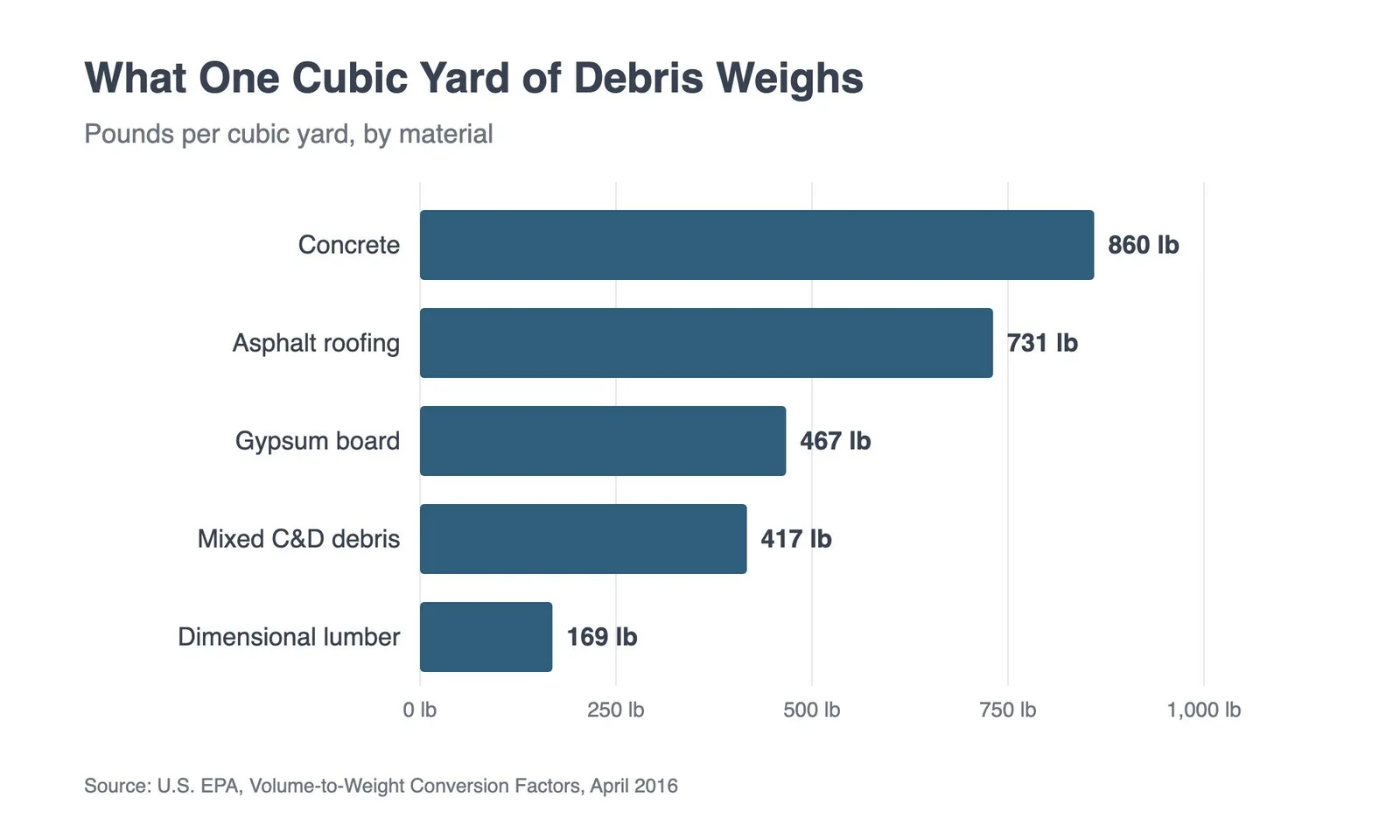
Source: U.S. EPA, Volume-to-Weight Conversion Factors, April 2016.
The spread is wide. Clean dimensional lumber comes in at 169 pounds per cubic yard. Mixed construction and demolition debris averages 417 pounds per cubic yard. Gypsum board, the drywall inside most finished buildings, is 467. Composition and other asphalt roofing is 731 pounds per cubic yard, and concrete is 860.
Those are averages for loose material, and real loads vary with moisture, how tightly debris is packed, and how many nails and fasteners, and how much dirt, come along with it. But the ranking holds, and it explains most surprises at the scale.
What that means for a full container
Container sizes are quoted in cubic yards, so the EPA factors translate directly into rough weights for a full load. The arithmetic is simple multiplication.
A 20-yard container filled with clean lumber, at 169 pounds a yard, holds about 3,380 pounds, or roughly 1.7 tons. The same container filled with mixed demolition debris holds about 8,340 pounds, a little over 4 tons. Filled with asphalt roofing, it reaches about 14,620 pounds, more than 7 tons.
The container did not change. The material did. That is why a roofing tear-off can hit a weight limit when the box still looks half empty, and why a load of old framing lumber can fill to the top without coming close.
Roll-off rentals are often priced with a set tonnage allowance and a charge for weight above it. Knowing roughly what the material weighs before it goes in is the simplest way to avoid paying for weight nobody planned on.
Why older buildings matter here
The age of a parish’s buildings is a rough guide to what will come out of them. The Census Bureau’s American Community Survey, summarized in the Census Reporter profile of Tangipahoa Parish, estimates 60,006 housing units in 2020 to 2024.
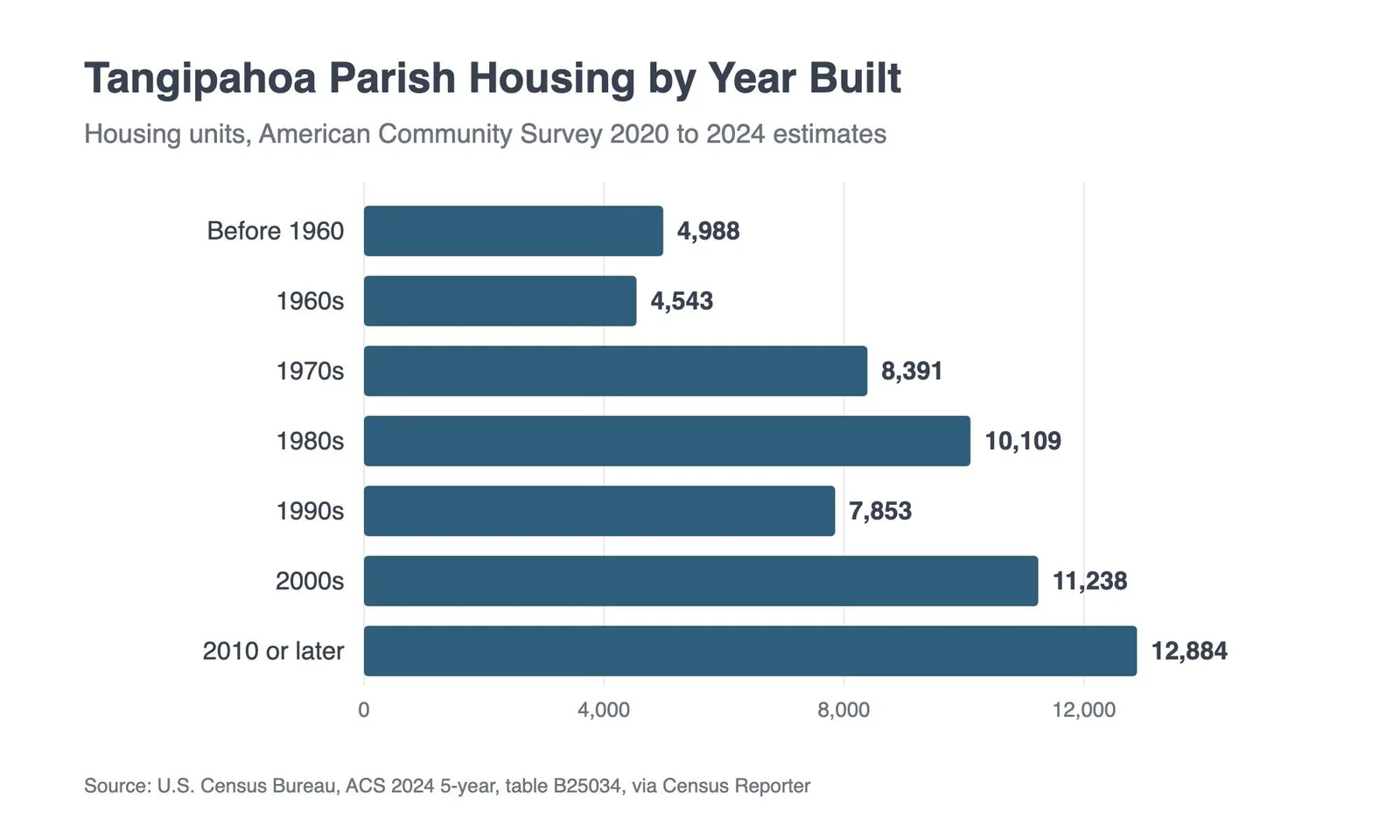
Source: U.S. Census Bureau, American Community Survey 2024 5-year estimates, table B25034.
Of those homes, 17,922 were built before 1980, about 30 percent. Counting everything built before 1990 brings the share to roughly 47 percent. Those figures cover housing units only. The survey does not count barns, sheds, or other outbuildings.
Older structures can carry heavier materials than newer ones, such as plaster in some interiors, concrete footings and slabs, and roofs replaced or patched over the years. When one of them comes down, it is worth assuming the load will run heavy.
Sorting before loading
The single most useful step on a rural tear-out is separating materials before they go into a container.
Vegetation is the first thing to pull out. Limbs, brush, and vines are a different waste stream, and in many Louisiana parishes yard waste is handled under different rules than building material. Concrete and masonry come next. They are the heaviest category per yard, and some disposal facilities and recyclers handle clean concrete separately from mixed debris.
Several items should not go into a standard roll-off container at all. Liquid paint, chemicals, solvents, motor oil, car batteries, propane tanks, tires, and appliances that contain refrigerant each need separate handling.
Fence lines can be a surprise. Rotted posts and rails are light, but wire, metal gates, and posts set in concrete add weight quickly.
Sorting also makes the weight easier to estimate. A container that holds only lumber, only roofing, or only concrete can be matched against a single EPA factor. A mixed load has to be estimated from the average, and the average hides the heavy pieces.
Placement on rural property
Weight also affects where a container can sit. A loaded 20-yard box filled with roofing can weigh more than many pickup trucks, and a soft pasture edge, a septic area, or a gravel drive that has never carried that kind of load can all be a problem.
Along state highways like LA 40 and LA 1062, the shoulder is state right-of-way, so containers are generally set on the owner’s side of the property line. Some haulers place boards under the container to spread the load and protect the surface beneath it.
Planning the job
For property owners around Loranger, the practical takeaway is to describe the material, not just the size of the building, when arranging a container. A barn with a metal roof and wood siding is a very different load from a farmhouse with asphalt shingles, plaster walls, and a concrete porch.
One local option is a Hammond-based roll-off company that lists Loranger among its service areas at cleanslatedumpsterrental.com. It puts the community about 18 miles from its yard and rents 15-, 20-, and 30-yard containers. The company was founded by Chris Martin in May 2025.
The EPA numbers will not predict any single load exactly. They do make one thing predictable: the heavier the material, the sooner a container reaches its weight limit before it reaches its rim.
About Post Author

You may also like
-
Desert Heat and the Contents of a Closed-Up Phoenix House
-
Why Most People Leave Too Early, According to Bestselling Author Chris Sund
-
The Two Wars We All Fight and What The Iliad and The Odyssey Teach Us About Balance Within Our Own Lives
-
How to Choose the Right Suit for Your Big Day
-
Traveling to the Caribbean with Kids: 15 Smart Tips for a Stress-Free Family Trip
