

Most families do not get to choose when an estate sale happens. A parent moves into care, a house needs to be listed, or an estate has to be settled, and the contents of a home suddenly need a plan.
In the Phoenix area, the calendar adds one more variable. For much of the year, the heat affects the house, the things inside it, and the people who come to shop, and it is worth planning around before the first price tag goes on.
Four Months Average Above 100 Degrees
The clearest way to see the problem is the normal daily high for each month. NOAA’s 1991 to 2020 U.S. Climate Normals are 30-year averages, and for Phoenix Sky Harbor International Airport they show how lopsided the year is.
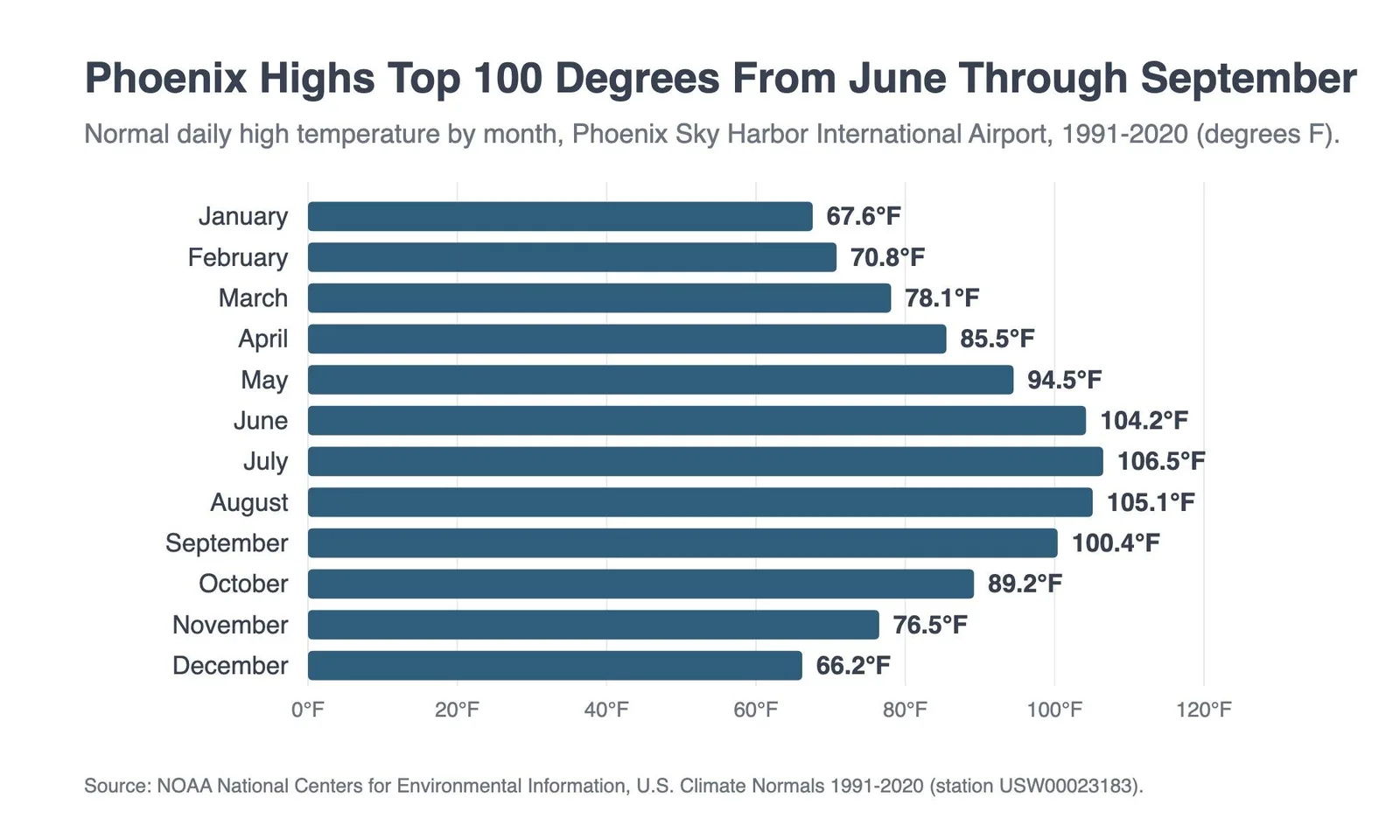
Normal daily high temperature by month at Phoenix Sky Harbor, 1991 to 2020.
The normal high runs from 66.2 degrees in December to 106.5 degrees in July. June, July, August, and September all average above 100 degrees, and May and October sit close behind at 94.5 and 89.2.
The winter months look very different. From November through March, the normal high stays between the mid-60s and the upper 70s, comfortable weather for walking through a house and carrying things to a car.
Counting the 100-Degree Days
Averages can hide how often the heat actually arrives. The same NOAA normals also count the average number of days each month when the high reaches at least 100 degrees.
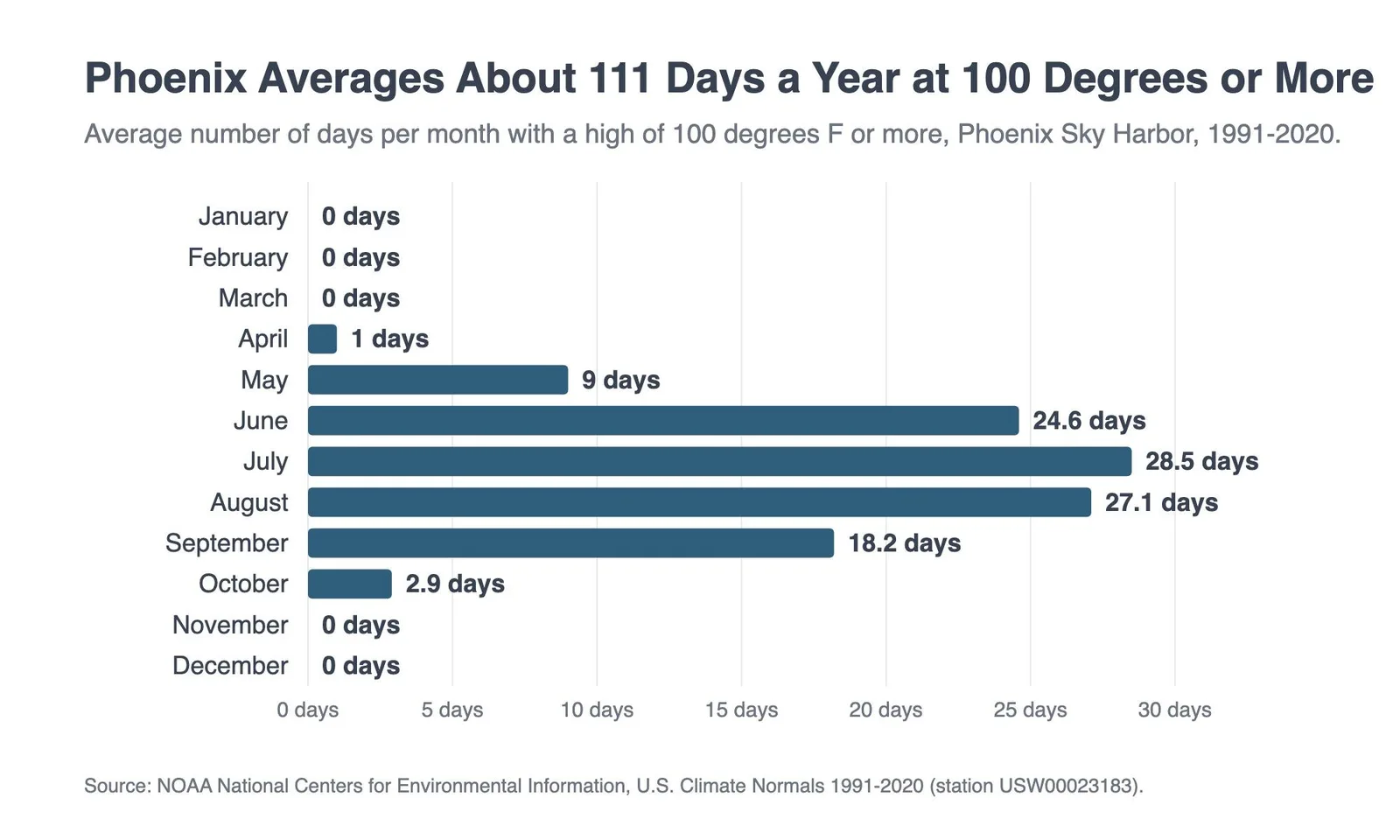
Average days per month at or above 100 degrees at Phoenix Sky Harbor, 1991 to 2020.
Phoenix averages about 111 days a year at or above 100 degrees. By our count of the monthly figures, about 98 of them fall between June and September, which is close to nine out of every ten.
July averages 28.5 such days out of 31. On the other side of the calendar, November through March average none, and April averages just one.
What a Closed-Up House Does to the Contents
Heat matters before the sale even opens. A home that sits empty for weeks or months while a family makes decisions may have its air conditioning turned up or off, and garages, attics, and sheds may never have been cooled in the first place.
Some belongings handle that well. Furniture, tools, glassware, and most kitchen items do not mind a warm room. Others are far more sensitive, and they are often the items families care about most.
Photographs are the clearest example. Library of Congress guidance on caring for photographs says they keep best in a relatively dry, stable space at 70 degrees or below. It advises against storing them in attics, basements, along exterior walls, or anywhere with extreme swings in conditions. For color photographs and film negatives, the same guidance names temperature as the controlling factor in how long they last.
Other items deserve the same caution. Vinyl records, candles, cassettes, videotapes, adhesive-backed albums, and older electronics can all suffer in a hot room. Moving them into a cooled part of the house early, or out of the house entirely, protects the ones the family wants to keep and the ones that will be sold.
Shoppers Feel the Heat Too
An estate sale depends on people walking through the house, lingering over shelves and carrying their finds to a car. On a 105-degree afternoon, that is harder for everyone, including the family members and helpers who are on their feet all day.
Heat changes the shape of a summer sale in a few practical ways:
- Hours shift earlier in the day, or later into the evening, so shoppers are not loading cars in the hottest part of the afternoon.
- Large items such as dressers, patio sets, and garage contents move more slowly when loading takes place in direct sun.
- Lines that form outside before opening need shade and water nearby.
- A house that is cooled during setup and the sale itself is more pleasant to browse, which keeps shoppers inside longer.
None of this means a summer sale cannot work. It means the schedule, the setup, and the hours need to account for the temperature rather than ignore it.
Planning Checklist for a Phoenix-Area Estate Sale
A short list helps a family sort out what can be decided now and what can wait for a professional. These steps apply in any season, but they matter most between May and October.
- Set the thermostat in a vacant house to a level that protects the contents, not just one that saves on the power bill.
- Move photographs, documents, records, and other heat-sensitive items out of the garage, attic, and exterior closets first.
- Pull out anything the family wants to keep before sale preparation begins, so it is not priced by mistake.
- Note any closing, listing, or move-out dates that fix the calendar, since those often decide the timing more than the weather does.
- Ask how sale hours will be set in the hottest months and how large items will be loaded and picked up.
When Timing Is Flexible, and When It Is Not
The NOAA numbers point to an obvious window. With no 100-degree days on average from November through March, the cooler months are easier on the house, the contents, and the people walking through it.
Real life does not always cooperate. A house may need to be cleared before a closing date, a lease may be ending, or an estate may have deadlines of its own. In those cases, the better question is how to run a sale well in the heat, not how to avoid summer entirely.
In the Phoenix metro, Busy Bees Concierge & Home Services is one company that runs estate sales in the Phoenix area, including Mesa, Scottsdale, Chandler, and Gilbert. The company says it runs about thirty sales a year. Its posted listings include July, August, and September sales in Phoenix, Mesa, Chandler, Scottsdale, Cave Creek, and New River, held from 8 a.m. to 2 p.m. Two September sales in Rio Verde were scheduled for late afternoon and evening hours. Alongside estate sales and liquidation, it lists home organization, packing and unpacking, interior design, and senior moves and downsizing.
Reading the Calendar Before Setting a Date
The heat in Phoenix is not a surprise, but it is easy to overlook when a family is focused on everything else that comes with clearing a home. The climate record makes the pattern plain: four months that average above 100 degrees, roughly 111 days a year at that mark, and a long, mild stretch from November through March.
A family that knows those numbers can make better calls about when to hold a sale, how to protect what is inside the house in the meantime, and what to ask before a single item is priced.
About Post Author

You may also like
-
Why Most People Leave Too Early, According to Bestselling Author Chris Sund
-
The Two Wars We All Fight and What The Iliad and The Odyssey Teach Us About Balance Within Our Own Lives
-
How to Choose the Right Suit for Your Big Day
-
Traveling to the Caribbean with Kids: 15 Smart Tips for a Stress-Free Family Trip
-
Is Microneedling Safe for All Skin Types?
