
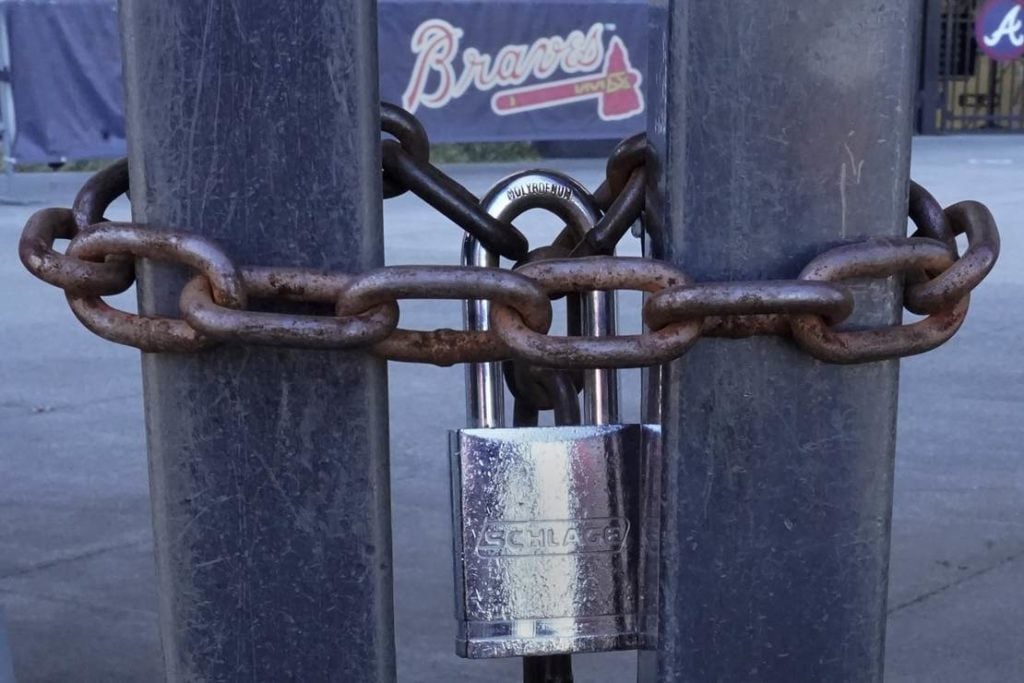
Here at the sports desk located somewhere below decks of the Good Pirate Ship RedState, we acknowledge that the weeks in-between the Super Bowl and the start of the NCAA men’s basketball tournament are pretty much the dog days of sports. While the basketball and hockey seasons continue, there is still no sign of a playoff push. Except for some musings about possible trades or potential draft picks, football is currently taking a break. Thankfully, there’s baseball spring training and … oh, wait …
Baseball has been the American cultural and sporting movement that unites generations since shortly after the Civil War. Despite all the financial duplicity and financial tricks of teams owners over the past century, baseball is still something that reminds us every year of how much life has to offer. Baseball has bonded America’s generations and America in a way that no other sport can. The game’s legends transcend time as even the non-sports minded know the names. Few can rattle off the different Presidents’ names a century ago, but everyone knows Babe Ruth.
Yet once again, the very entities entrusted with baseball’s maintenance and growth seem fiercely determined to destroy that with which they have been charged. Right now, spring training needs to be underway. Only lizards can dart across Arizona and Florida fields. Cancellation of the second and third series in regular season. It is a laughing matter that owners and players have been trying to negotiate. Players are creating funds and, allegedly, the owners to assist stadium workers who have been affected by the cancelation of games. It is not clear when this will be over. More cancellations? Abbreviated Season, which is rescheduled only for divisional matches. A single season?
Owners and players can be contentious, but they are also financially motivated. Everyone in professional sports is making money. It’s with how much, and from whence it comes, that issues arise.
The first is broadcasting. The broadcasting of the NFL has been a national business since 1960. This excludes pre-season TV and radio which, for most teams, return little compared with national broadcast revenues. The revenue from the broadcast deals is divided equally among all teams. This ensures a large income for each team and eliminates any excuse for your poor football performance year after year. My bragging is enough.
National broadcast revenues are shared by the three other major sports. Still, they are far more dependent on local revenue, be it from broadcast rights or ticket sales (for conciseness’ sake, we’re lumping luxury suites in with tickets). To try and level the paying … er, playing field a bit, basketball and hockey have somewhat convoluted rules that encourage teams to re-sign their players by allowing the team to offer a fatter contract than the player could make going elsewhere as a free agent.
NHL teams cannot have payrolls exceeding $81.5 million or less than $60.2 millions. For the next season, it will have a soft $208.2million hard cap. The hard cap is also lower, at $180 million in 2021. The NBA’s salary cap and sub-categories are sufficiently Byzantine to require scholarly websites devoted to nothing but explanations thereof, although this summary at SB Nation works well:
- The NBA sets a salary cap based on the previous season’s revenue. The soft cap allows teams to spend more than the limit.
- As the salary floor, teams must use 90% of their salary cap. A team must spend 90% of the salary cap to reach the salary floor. They are responsible for paying the difference between their salary and the roster salary to their members.
- Teams are allowed to spend above the salary cap without penalty until they hit the luxury tax line, after which they must pay additional fees depending on how much they exceed the limit and if they are “repeat offenders.”
- Certain contracts may not be counted towards the luxury or cap tax.
- NBA divides revenue 50/50 among the league, players.
Thank you. Especially when you start adding things like dead money, which isn’t as morbid as it sounds. Instead, it’s the term applied to salary owed a player no longer on the team. Not surprisingly, a career as a sports lawyer can be a great choice.
And then there’s baseball.
There is no upper or lower salary cap in baseball. The teams can spend whatever they like. You have Pittsburgh Pirates that are on an active payroll. The active payroll for the Pittsburgh Pirates is $21.45 Million, compared to $235.6 millions for the New York Mets. Gee, wonder which team’s fan base likes its ownership more. But I digress. There is a luxury tax for teams paying more than $210 million in salaries, but at that point, if you’re spending that much, who cares about a few extra million. This raises the question of whether this is sports or the government we’re talking about, but let’s not go there.
Owners would be thrilled to have a salary cap. Players, not so much.
0%. To say cap on the union is to say Voldemort at Hogwarts. It is not a good idea.
An early negotiation resulted in MLB offering a $100M salary ceiling. The threshold included $180M in CBT. This would have allowed overages to be subsidized by lower-revenue clubs. According to the union, it wasn’t worthwhile. https://t.co/RImBiLBcim
— Jeff Passan (@JeffPassan) February 17, 2022
A quick look at the current salary situation shows that under this proposal, four teams would pay a luxury tax, and 14 teams would have to start putting more zeros in their player’s paychecks. Before rejecting this proposal, the players’ association may want to revise its calculations.
Of course there are other problems. The players want a system to strongly discourage teams from tanking in the form of getting rid of … er, trading any and all players showing star ability before they reach the point where they’re ready for their first fat contract. In exchange, said teams get a bunch of prospects and draft picks so they can “rebuild.” Which, amazingly enough, always translates into doing the same tanking routine when said prospects and draft picks develop into players showing star ability. (But enough about my A’s.) Other items include chicanery and service time. A decent description of each issue is found at the end of the Baltimore Sun article.
In short … guys, we love baseball. We don’t like you. We already dislike you. Baseball belongs to Use this siteIt’s not you. How’s about, for a change, respecting the game and the fans, sitting your collective butts down, getting real, getting a deal done, and playing a little ball before you destroy every shred of interest in the sport itself?
About Post Author

You may also like
-
The European Union’s Path to Less Packaging Waste
-
How Commercial Roof Maintenance Can Improve Property Management
-
The Untraceable Isn’t Unprovable: Shantonia Wayne on the Paper Trail Behind Citizenship by Descent
-
The statistic behind every future-of-work speech deserves a closer look
-
Leigh Tesar Scheme Allegedly Targeted Terminally Ill Patients with High-Payout Wound Procedures
