

Traditionally, financial institutions have relied upon tri-merge credit reports to obtain a prospective borrower’s information. This method involves ordering credit reports from TransUnion, Equifax, and Experian to see the full breadth and depth of a consumer’s financial history. However, some lenders have tried shifting to a single score or bi-merge approach, which involves using 1 or 2 credit bureaus respectively. So, what kind of differences do these 2 approaches have?
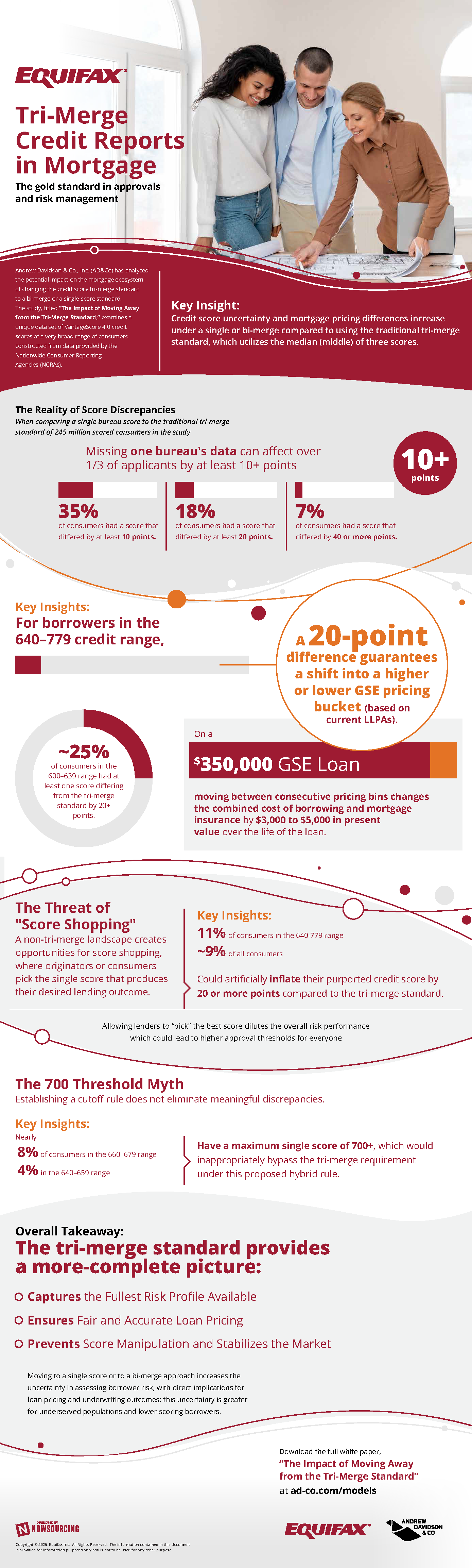
When studying 245 million consumers, there have been very large score discrepancies. Missing even 1 bureau’s data resulted in one-third of consumers having a credit score difference of 10 points or more. Around 20% of consumers saw a credit score discrepancy of 20 points or more. In practice, this can easily place a prospective borrower into an incorrect pricing bucket. On a $350,000 loan, this could result in a consumer being overcharged or undercharged between $3,000 and $5,000.
Fortunately, it is easy to avoid some of these problems. By ordering credit reports from all 3 bureaus allows lenders to reduce credit score variance and ensure they aren’t leaving any money on the table. Ultimately, to ensure complete accuracy in loan pricing, ordering a tri-merge credit report is the only way to go.
Source: Equifax
About Post Author

You may also like
-
The European Union’s Path to Less Packaging Waste
-
How Commercial Roof Maintenance Can Improve Property Management
-
The Untraceable Isn’t Unprovable: Shantonia Wayne on the Paper Trail Behind Citizenship by Descent
-
The statistic behind every future-of-work speech deserves a closer look
-
Leigh Tesar Scheme Allegedly Targeted Terminally Ill Patients with High-Payout Wound Procedures
