
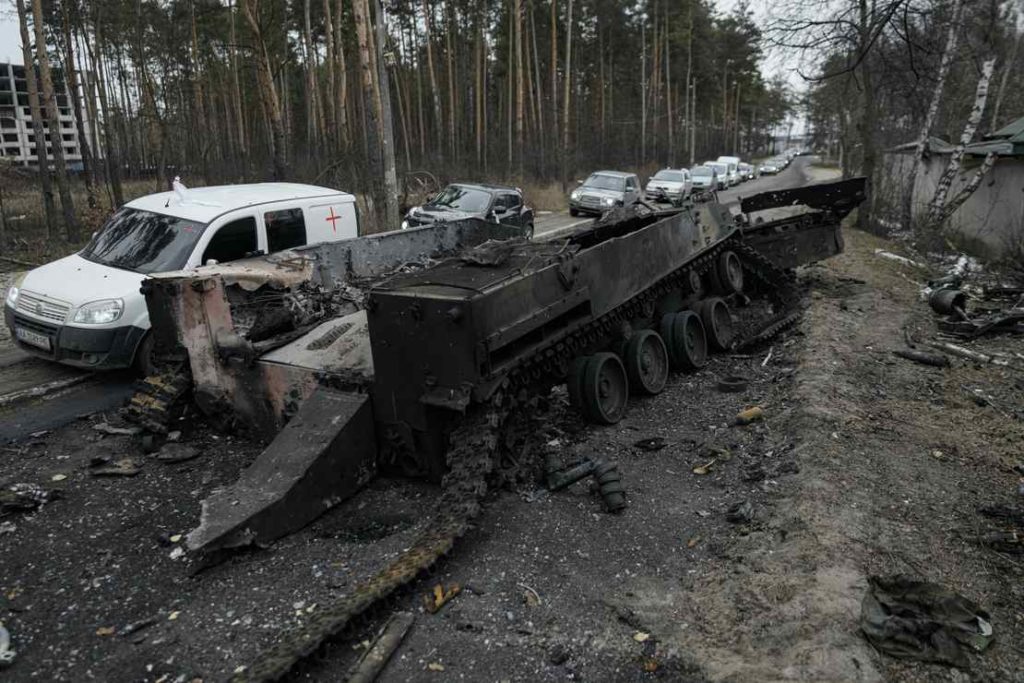
Towards the end of March, at a point where Putin’s War seemed to be unraveling, but some of us were still having trouble coming to grips with the abysmal performance of the Russian armed forces, an amusing story hit the internet. Some 300 South Ossetian soldiers who had volunteered to give their lives for their country’s puppeteer in Ukraine showed back up home. From the battleground, they had traveled 500 miles by foot and hitchhiked back to their home.
https://www.youtube.com/watch?v=DlktB0uTDLo
I don’t know that Putin was humiliated or capable of feeling that emotion, but his military chiefs had made a big show of all the loyal friends of Russia showing up to kill the nasty nazis in Ukraine. It was at most untoward for 300 people to walk home. At home it raised eyebrows as well.
Ex-President of South Ossetia urged not to jump to conclusions, not to accuse them of deserting, but to investigate carefully the circumstances in which soldiers were sent on combat missions without full equipment and stock of weapons.
— Alik Puhati (@rajdianos) March 30, 2022
The border between Russia and South Ossetia was occupied by a group of former soldiers. They hitchhiked back home. pic.twitter.com/gISBRqwXZ9
— Alik Puhati (@rajdianos) March 30, 2022
South Ossetia’s parliament voted in support of soldiers returning to Ossetia after a Ukrainian special operation. He said that no one can accuse Ossetians of being cowardice. pic.twitter.com/OS3SxTsN2L
— Alik Puhati (@rajdianos) April 1, 2022
His conviction is that we now must determine who sent our troops to fight operations without the ammunition they needed, and condemn them to their deaths.
— Alik Puhati (@rajdianos) April 1, 2022
More information on that debacle was made available today in an interview South Ossetian President Anatoly Bibilov had with the “deserters.”
It is followed by an appropriate Festivus Celebration-worthy Airing of Grievances.
Bibilov wanted the soldiers present to share their experiences. If you’ve ever been a commander and seen soldiers given the opportunity to tell higher authority all the things that went wrong, you know how this movie ends.
It’s amazing. South Ossetia’s soldiers claim that their deserting and returning home was due to the total chaos and incompetence caused by Russia’s command in Ukraine. The soldiers say that huge quantities of equipment don’t work. https://t.co/yXYygYGLIl pic.twitter.com/7cZpUG7Ia1
— Neil Hauer (@NeilPHauer) May 4, 2022
Bibilov is done and says to the troops, “Suck it up!” Then real communication starts. Bibilov and his troops engage in a verbal sparring match.
Bibilov attempts to calm down the military
“You know better than me that wars are not always won by technology. Many of these people fought in 2008 without any equipment. Two or three grenade-launchers would suffice. For example, I didn’t like your speech, ”he turns to the refusenik, who said that they were sent to fight not for their homeland. – If something happened here, in our Ossetia, and if you were there, I will tell you: you are not a strategist, you are not a tactician, and there are people who think about Ossetia. You should never ask this question.
Everyone in the hall started to shout. Someone reminded Bibilov of the death of Inal Dzhabiev, a resident of South Ossetia — in August 2020, he died on his way to the hospital from a temporary detention facility. Dzhabiev’s relatives are sure that he died due to torture during interrogation.
– When the Dzhabievs were sitting on the square, why didn’t you go out to them? You were where? – a question is heard from the audience.
— Have you done a lot for Dzhabiev? Bibilov shouts back, and then he slams on the table. “Do you know what happened to him?” Cover your mouth a little! Is that what jumped out? You even knew him! Do you even know him?
Then the head of the republic recalls that for the sake of South Ossetia “many people died – Russians and other different nationalities”: “And now you are telling me that if something happened here, in Ossetia, we would be left alone? If these fascists, Nazis appear in Ukraine, don’t you think that they will be here on the second day, in Ossetia?”
Bibilov notes that Ossetia will be the first “to come to an end” if “Russia stumbles”: “Know that we are fighting there, but we are defending our homeland.”
“We should have stayed there,” he scolds the soldier. We did everything necessary to keep there. It is important to understand, that no matter the reason, war has different concepts. Do you think I don’t know that there is no equipment there, that there are bad weapons? This is something that everyone understands, and will all understand. To say that I blame you – no, but we should have stayed there.
Bibilov said that he planned to travel to the front himself, so the men had to wait to see his arrival.
Someone in the hall notes that no one informed them about Bibilov’s arrival. “I called Radik, probably, he could not tell everyone separately,” the head of the republic says to this.
[If you are using Google Chrome, right-click and select “Translate to English.”]
This is a funny observation, but it indicates a serious problem within the Russian Armed Forces. We can see that Russia’s armed forces were not designed for resistance in combat.
Over the last two months, numerous stories have been circulating about endemic desertion, defection, combat refusal, and worse (Report: What Russians Did to Their Commander Shows How Much Trouble They’re In) in the Russian armed forces involved in Putin’s War.
The US also has indications that Russian officers are “frustrated with their troops’ performance, frustrated with their colleagues’ performance,” said the official.
— Barbara Starr (@barbarastarrcnn) April 13, 2022
Russia seems to be reverting back to an old-and-true way of deterring desertion.
Putin sends in ‘execution squads’ to kill Russian deserters https://t.co/LmHD1Fe9MR
— Daily Mail Online (@MailOnline) March 23, 2022
It is reported that one of Putin’s favorite auxiliary forces, Chechen thugs personally loyal to Chechen President Ramzan Kadyrov, were the spark that set off a firefight between Russian units because they served as the enforcers to keep other troops from retreating and used that opportunity to pick over the loot the attacking troops have to leave behind.
[2]The revolted, it is claimed #BuriatRussian soldiers were furious and disappointed that they had been fired. #KadyrovitesAlthough they didn’t join them in fighting, the Chechens threatened to kill Buriats should they withdraw from the battlefield. Source: Intel Dept of Ukraine MoD.
— Victor Kovalenko (@MrKovalenko) April 29, 2022
[3]Furthermore, #BuryatYou can find the #RussianMilitary soldiers opened fire at their compatriots #KadyrovitesBecause they stole the majority of the Buryat soldier’s staff from locals, and also took the property of abandoned homes of #Ukrainians. Source: Intelligence Dept of Ukraine MoD.
— Victor Kovalenko (@MrKovalenko) April 29, 2022
Mongolian people are known as the Buryat. They aren’t the Chechens.
According to reports, there was a gunfight between Russian forces at Kiselivka (in the Kherson area).
After the Chechens stole the goods from Ukrainian homes, 50 Buryats began shooting at 50 Chechens.
Killed & injured on both sides before FSB intervened. pic.twitter.com/xJEYDDRWMz
— Visegrád 24 (@visegrad24) April 29, 2022
Although it’s not a novel idea to use one ethnic group to maintain order among other minorities, it can be a problem for morale. (As an aside, a guy in my fencing club in Chicago was a Jewish “refusenik” who was permitted to immigrate thanks to Reagan and a Red Army veteran. He’d been stationed on the Amur River during one of the many border crises between the USSR and CCP. I was told by him that there were frequent firefights among ethnic groups within the Red Army.
The Russian military faces another challenge. This is because it is mostly made up of ethnic groups from Central Asia.
That’s why Russian army is increasingly turning into the army of minorities. It has been an army of country people since its inception. They were mainly ethnic Russian in their past. However, today there are fewer young people living in the Russian ethnic countryside. pic.twitter.com/GxTzB0DK1I
— Kamil Galeev (@kamilkazani) March 23, 2022
5. It’s time to start talking with minority POWs, check their views and recruit those who could potentially change sides. The Russian army relies heavily on minorities for cannon fodder. Which region had the highest number of people drafted into Central Military District by 2021? Bashkortostan pic.twitter.com/sHvxheMg2a
— Kamil Galeev (@kamilkazani) March 28, 2022
Most of dead 🇷🇺 soldiers are servicemen from poor regions, highest losses come from 2 Russian republics Dagestan and Buryatia. Average monthly income is about 20k rubles. (EUR 225) St. Petersburg & Moscow are all but absent among KIA https://t.co/wOzLHBRm6F pic.twitter.com/K8s1vvXNRm
— Euromaidan Press (@EuromaidanPress) April 26, 2022
Most of the ethnic Russians serving in the military came from orphanages. These children are removed from their families when they turn 18 years old and given no support. So Putin’s War has its own grim echoes of “It’s a rich man’s war and a poor man’s fight.”
I’ve posted before on how Putin’s armed forces are structured (Russia Calling 100,000 Reservists to Active Duty and Moving Wagner Group From Syria to Deal With Ukraine Manpower Crunch). Russia was deprived of virtually unlimited access to manpower from Ukraine, Belarus and other countries that were no longer part of the USSR. The Russian army tried to combine the cannon-fodder of soldiers with professional Western troops, which included a corps of professional noncommissioned officers. The noncommissioned officer experiment was abandoned 20 years ago. Now, all management and leadership tasks are performed by commissioned officers. To make matters worse, they created a system where conscript soldiers can’t legally be sent to combat without an official proclamation (they are, but that is stereotypical Russian scoffing at the rule of law at work), but the “professional” contract soldiers can quit at any time unless there is a declaration of martial law.
Problem is, the Russian armed forces are not like those of either the USSR or the West.
Many refuse to leave work or go to war. Russian media reported that hundreds or even thousands of Krasnodar OMONs, Crimean Marines, Pskov Airborne soldiers, South Ossetia and Hakas National Guard members refused to fight. You can see a conversation between a National Guard boss and his fighters. pic.twitter.com/ZkLO4hXesX
— Kamil Galeev (@kamilkazani) May 4, 2022
Some commanders try to destroy the record of the military who quit, putting a special notes or stamps into their military IDs (военный билет), personnel files, etc. If you are not planning to work for government, however, that will have little impact on your future. You can also sue them pic.twitter.com/c7Zkl7YC4g
— Kamil Galeev (@kamilkazani) May 4, 2022
The troops that had already left for war, and who were then returned to their homes in Pskov refused to return to the conflict. For example, after the VDV were massacred in Ukraine, around 100 airborne from Pskov who were returned home from Belarus, refused to go to the war again https://t.co/hv7tg0LI0w
— Kamil Galeev (@kamilkazani) May 4, 2022
Leadership is essential for maintaining discipline within the Armed Forces. Combat requires effective leadership, primary group bonding, and good leadership. The Russian military uses dedovshchina, a brutal form of hazing to keep its units together. Victimizers will often be the leaders that the victims are expected to follow in battle.
What about the poor souls?
Nope. Still russian dedovschina. Is putin forcing them? Or is this a sickly fucking Russian society which uses violence to kill without regard for human dignity and well-being? pic.twitter.com/NxOWk7N3kn— Дід мілаш (@die_bitches_die) March 30, 2022
My assessment is that the structure and nature of the Russian armed forces indicate that Putin’s War is not sustainable. Russia gave almost 80% its combat battalions for the invasion of Ukraine. The reserve force cannot rotate units outside of the lines, therefore combat units must continue fighting until the combat ceases to be effective. For 70 days, the units that were expected to win in Donbas or other operations have been fighting almost continuously. It hasn’t been an easy 70 days; losses in manpower and equipment have been massive. The next battles will be more brutal as Ukraine achieves a quantitative (Ukraine Now Has More Tanks Than Russia and Things Look Worse in the Future) and qualitative (US Artillery Delivered to Ukraine Is More Than Guns, It Is a Game-Winning Change From the Present) superiority in weaponry. The Russian military is at the brink of collapse based on all that we know about combat men.
About Post Author

You may also like
-
The European Union’s Path to Less Packaging Waste
-
How Commercial Roof Maintenance Can Improve Property Management
-
The Untraceable Isn’t Unprovable: Shantonia Wayne on the Paper Trail Behind Citizenship by Descent
-
The statistic behind every future-of-work speech deserves a closer look
-
Leigh Tesar Scheme Allegedly Targeted Terminally Ill Patients with High-Payout Wound Procedures
