
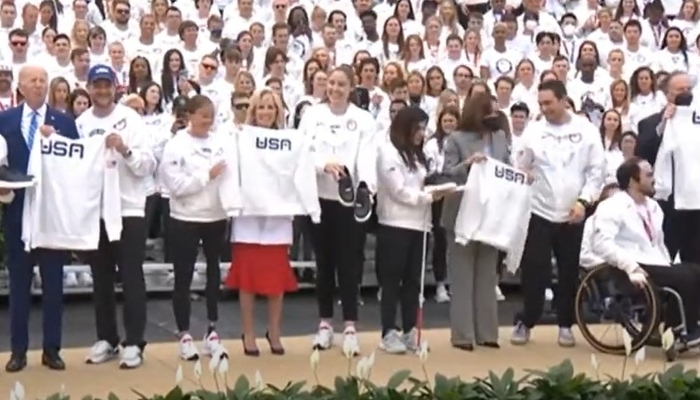
Open mouth, insert presidential foot. While appearing on the South Lawn of the White House at a photo opportunity with Olympic and Paralympic athletes Wednesday, President Joe Biden committed another gaffe by telling wheelchair-bound athletes not to jump during a photograph.
The blunder came at a White House reception to honor 600 Olympic and Paralympic athletes who competed for Team USA in the 2022 Beijing Winter Olympics and the 2021 Tokyo Summer Games.
Preceding the gaffe, Olympian Elana Meyers Taylor praised “wheelchair player Matt Scott.” Taylor and the president then posed for a group photo, and he yelled, “Here we go. Don’t jump. She’s our photographer. Look at her,” as the photo was being taken.
Some reports say it was a joke and it drew laughter. If that’s what it was, it was a bad, insensitive joke.
RedState called it yet another of the president’s cringeworthy moments.
Biden went on to remark, “You’ve been through so damn, darn much. Your efforts helped unify the country.
“In you, I see who we are as a nation. We believe in America, anything is possible, and you are the explanation of what we mean.”
Biden’s history includes blunders that have involved disabled Americans. In 2008, while running for vice-president, he told Missouri State Senator Chuck Graham to “stand up, let ‘em see ya.” Sen. Graham is wheelchair bound. Biden then tried to excuse away his blunder by saying, “You can tell I’m new.”
New? He’d been in Congress for more than 35 years.
This president can’t use the “I’m new” excuse anymore, not with his condescending remarks to Paralympians.
About Post Author

You may also like
-
Beyond Star Ratings: Why Transparent Customer Feedback Matters in Emerging Scientific Industries
-
When Two Laboratory Samples Share the Same Name but Not the Same History: The Importance of Batch-Level Scientific Documentation
-
When Two Scientific Studies Disagree: Why Conflicting Peptide Research Results Do Not Always Mean One Is Wrong
-
Inner Work: Gaining Success by Developing Your Inner Self
-
The Moving Quote That Changes After Your Belongings Are Loaded: What Federal Rules Actually Say About Binding Estimates, Surprise Charges and Consumer Rights
