
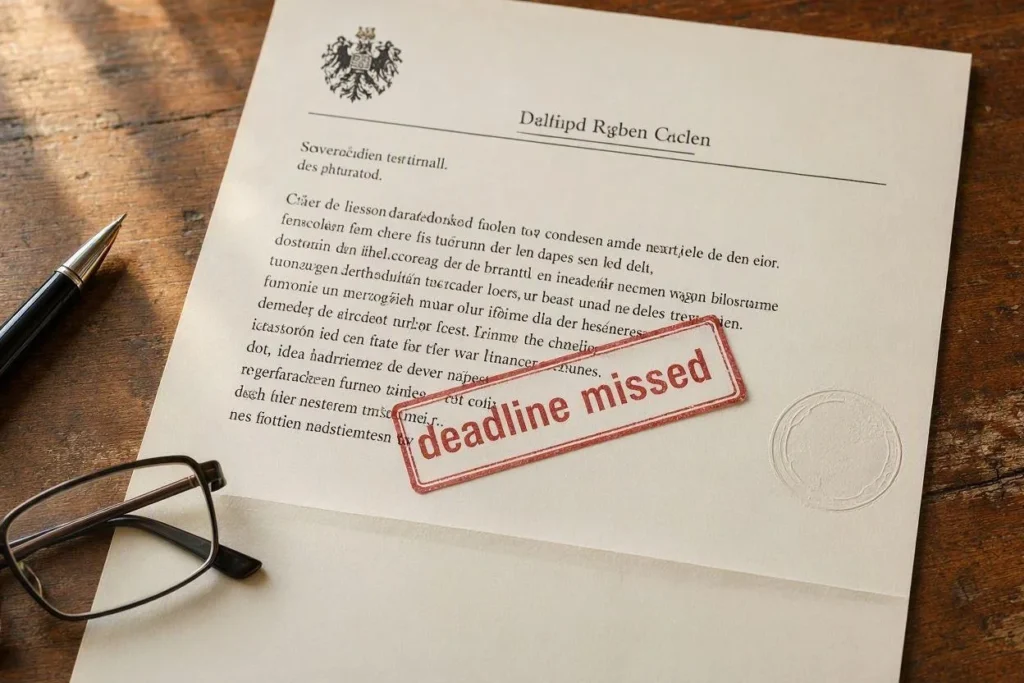
Vienna prosecutors filed their appeal within the four weeks the judge granted. Still, Austrian law allowed only two, leaving Washington with an active indictment and no defendant to prosecute in Chicago.
WASHINGTON, D.C., September 16, 2026: A fatal Austrian appeal deadline has ended the United States government’s twelve-year effort to extradite Ukrainian businessman Dmytro Firtash from Vienna for trial on federal bribery, racketeering, and money-laundering charges.
The Vienna Higher Regional Court dismissed the prosecution’s challenge to a lower-court immunity ruling after finding that the appeal was filed outside the statutory two-week period.
The result became particularly controversial because the first-instance judge had expressly told Vienna prosecutors they had four weeks to file the appeal.
Prosecutors complied with the period the judge granted, but Austria’s Supreme Court later ruled the extension unlawful, making the filing late under the controlling statute.
A final application to restore the missed deadline failed in March 2026, leaving no additional Austrian appeal and permanently closing the surrender proceeding initiated after Firtash’s 2014 arrest.
The procedural failure represents a major defeat for the United States Department of Justice. Still, it did not destroy the Chicago indictment or conclusively prevent Firtash from being arrested abroad.
No Evidence Washington Is “Reeling”
American prosecutors publicly criticized the underlying Austrian immunity decision and described its recognition of Firtash’s disputed Belarusian diplomatic status as erroneous.
They expected Austrian prosecutors to appeal and plainly disagreed with allowing diplomatic credentials issued years after Firtash’s arrest to block surrender.
However, no publicly identified Justice Department or FBI statement after the final ruling describes federal officials as furious, reeling, panicked, or threatening retaliation.
Such descriptions are editorial characterizations rather than reported statements from identified officials.
The documented reaction is serious legal disagreement and disappointment after an unusually long international prosecution effort.
That established defeat is significant enough without attributing emotions that American agencies have not publicly confirmed.
More Than a Paperwork Paper Cut
The missed deadline can be described as a procedural disaster, but calling it a minor paperwork error understates the complexity and legal importance of what occurred.
Appellate deadlines determine when judgments become final and prevent parties from reopening cases indefinitely.
Government prosecutors are ordinarily bound by the same filing rules as private litigants, even when the underlying proceeding involves international corruption and a powerful requesting state.
The unusual aspect of the Firtash case is that prosecutors did not simply forget a date or misplace their documents.
They relied upon the first-instance judge’s express direction that four weeks were available, only to learn later that the judge had no authority to grant the extension.
The result combined judicial error, prosecutorial reliance, and strict appellate procedure.
The FBI Investigation
The FBI’s original announcement of Firtash’s arrest stated that the charges arose from an investigation the Bureau had conducted for several years.
A Chicago federal grand jury returned the five-count indictment under seal on June 20, 2013.
Austrian authorities arrested Firtash in Vienna on March 12, 2014, acting upon an American provisional-arrest request connected to that indictment.
The investigation concerned an alleged international enterprise seeking government licenses for a titanium-mining project in India.
The Austrian ruling did not invalidate the FBI’s investigative work, order the destruction of records, or prevent federal prosecutors from retaining the evidence.
It ended the legal process through which Washington intended to obtain Firtash from Austrian territory.
The Alleged Bribery Enterprise
Federal prosecutors accuse Firtash and five other foreign defendants of participating in an enterprise seeking authorization to mine titanium-bearing minerals in the Indian state of Andhra Pradesh.
The government alleges that Firtash led the operation and authorized about $18.5 million in bribes to Indian state and central government officials.
The alleged payments were intended to secure mining licenses and regulatory approvals required to develop an ilmenite project capable of producing titanium sponge.
Firtash allegedly met government officials, directed subordinates to disguise corrupt transfers as legitimate commercial payments, and appointed associates to coordinate the alleged bribery operation.
Members of the enterprise allegedly used American financial institutions and completed fifty-seven transfers totaling approximately $10.6 million between 2006 and 2010.
The federal charges include racketeering conspiracy, money-laundering conspiracy, interstate travel in aid of racketeering, and conspiracy to violate the Foreign Corrupt Practices Act.
Firtash denies wrongdoing, disputes American jurisdiction, and remains presumed innocent because no jury has adjudicated the charges.
Why Chicago Asserted Jurisdiction
The proposed Indian project anticipated supplying titanium sponge to an American aviation company headquartered in Chicago.
The unnamed company was subsequently identified publicly as Boeing, which considered a potential supply arrangement but did not complete the transaction.
Boeing has not been accused of participating in, authorizing, knowing about, or benefiting from the alleged bribery.
Firtash’s lawyers argued that he had never visited Chicago and that the alleged conduct involved an Indian mine, Indian officials, and transactions occurring principally outside the United States.
They maintained that federal prosecutors lacked a sufficient jurisdictional connection to apply American criminal law.
United States District Judge Rebecca Pallmeyer rejected Firtash’s motion to dismiss in 2019, finding adequate alleged connections through American financial transfers and the intended effect upon a Chicago-based company.
That ruling preserved the indictment but did not establish guilt or provide the United States with physical custody.
Arrest and Record Bail
Firtash obtained release nine days after his Vienna arrest by posting €125 million, approximately $174 million at the exchange rate reported in 2014.
The amount became the largest bail payment recorded in Austria.
He pledged to remain inside the country while extradition proceedings continued and subsequently surrendered his passport under court-imposed restrictions.
Firtash did not disappear or conceal his whereabouts from the FBI.
He lived openly in Vienna while prominent Austrian and American lawyers challenged his surrender in court.
The record bond permitted conditional liberty while effectively confining him to Austria for almost twelve years.
Austria’s Initial Refusal
In April 2015, a Vienna judge rejected the American extradition request after accepting defense arguments that the prosecution appeared politically motivated.
The court questioned elements of the American evidentiary presentation and expressed concern about the timing of Firtash’s arrest following the removal of Ukrainian president Viktor Yanukovych.
The Justice Department denied that the prosecution was connected to Ukraine’s political revolution and emphasized that the investigation had begun several years earlier.
Austrian prosecutors appealed successfully.
In February 2017, the Vienna Higher Regional Court reversed the initial refusal, finding that the political-motivation conclusion had not been sufficiently substantiated.
The appellate court determined that the allegations qualified as extraditable criminal offenses and permitted the surrender process to continue.
Washington Appears to Win
Austria’s Supreme Court upheld the extradition authorization in June 2019.
The Austrian justice minister subsequently approved Firtash’s surrender to American authorities, apparently completing the principal judicial and executive requirements.
At that stage, Washington appeared close to placing Firtash before the federal court in Chicago.
The transfer did not occur because Firtash’s lawyers continued to seek to reopen the proceeding based on new evidence and legal arguments.
A regional court rejected reopening in March 2022, but the Higher Regional Court reversed that decision in June 2023 and ordered additional examination.
That reopened proceeding made a Belarusian diplomatic designation the central barrier to extradition.
The Belarusian Immunity Claim
Belarus appointed Firtash as an adviser to its permanent representation to international organizations in Vienna and reportedly transmitted diplomatic notes connecting him to UNIDO.
The designation occurred in 2021, approximately seven years after his arrest and after Austria’s Supreme Court had already authorized surrender.
Firtash’s lawyers argued that the appointment provided immunity as a state representative participating in the United Nations Industrial Development Organization.
The timing and circumstances generated suspicion that Belarus created the diplomatic role specifically to obstruct the American request.
However, no final Judgment established that Belarus acted fraudulently or criminally when issuing the designation.
The appointment is therefore best described as strategically timed, disputed, and ultimately effective in the Austrian proceeding.
Austria and UNIDO Refuse Accreditation
Austria’s Foreign Ministry reportedly declined to recognize Firtash as properly accredited and did not issue the identification normally carried by accepted diplomatic representatives.
UNIDO also refused formal accreditation, creating a direct dispute among Belarus, the host government, and the international organization.
Diplomatic immunity does not ordinarily arise from a government title or passport alone.
The applicable treaty, recognized diplomatic function, notification procedures, accreditation, host-state acceptance, and scope of the claimed protection can all affect whether immunity exists.
Amicus International Consulting’s analysis of diplomatic passports and immunity explains why the document itself must be separated from the legal status necessary to resist arrest or extradition.
The Firtash case became exceptional because Austria’s criminal judiciary disagreed with the executive and international authorities responsible for conventional accreditation.
The November 2024 Decision
On November 4, 2024, the Vienna Regional Court for Criminal Matters declared Firtash’s extradition inadmissible because he possessed immunity under international law.
The judge concluded that Austria’s courts were not legally bound by the Foreign Ministry’s administrative opinion, invoking the separation between judicial and executive authority.
Under the Judgment, Belarus’s diplomatic notification generated sufficient protection even though Austria and UNIDO declined formal accreditation.
Austria’s Foreign Ministry reportedly described the decision as legally incorrect in both reasoning and result.
American prosecutors also rejected the conclusion, emphasizing that Belarus supplied the claimed diplomatic credentials years after Firtash’s arrest.
The United States expected the ruling to receive substantive appellate review.
The Four-Week Error
The first-instance judge informed Vienna prosecutors that they had four weeks to file their challenge.
Austrian criminal procedure allowed only two weeks, and the judge lacked legal authority to double the statutory period.
Prosecutors relied upon the four-week direction and submitted their appeal within the period granted by the court.
However, the filing arrived after the legally controlling two-week deadline.
Austria’s Supreme Court ruled on October 7, 2025, that the extension was unlawful.
Once the extension was removed, the prosecution’s appeal became late regardless of its compliance with the first-instance judge’s direction.
The Appeal Is Dismissed
On December 9, 2025, the Vienna Higher Regional Court dismissed the prosecution’s appeal as inadmissible.
The court did not examine whether Belarus had validly created diplomatic immunity or whether Austria’s Foreign Ministry had correctly refused accreditation.
It did not endorse every part of the lower court’s reasoning or decide whether the appointment was designed to obstruct extradition.
The appellate judges enforced the filing deadline, making the first-instance immunity ruling legally binding.
As Austrian reporting later explained, the court did not conduct any substantive appellate review of the disputed immunity Judgment.
The Last Attempt
Vienna prosecutors filed an application on December 23, 2025, asking the Higher Regional Court to restore the missed deadline.
They argued that the delay arose because they relied upon an appeal period expressly granted by the judge.
Restoration would have allowed the appellate court to examine the immunity decision and potentially revive the previously approved extradition.
On March 6, 2026, the Higher Regional Court refused the application.
Austrian law provided no further appeal from that refusal, definitively ending the proceeding.
The March decision was therefore the actual final procedural endpoint, even though the December dismissal attracted greater international attention.
Did the Deadline Doom the U.S. Criminal Case?
The deadline doomed the American effort to obtain Firtash through the Austrian proceeding initiated in 2014.
It did not dismiss the federal indictment or prevent the Justice Department from retaining the arrest warrant.
An Austrian extradition court determines whether Austria may surrender a person, while a Chicago federal court determines whether the American charges are valid and proved.
The two proceedings are legally distinct.
The missed deadline left the United States with an indictment and evidence but without the defendant necessary to conduct an ordinary trial.
That makes the prosecution operationally stalled rather than formally dead.
Was This a Twelve-Year Chase?
American authorities wanted Firtash for almost twelve years, but he was not the subject of a conventional search after his arrest.
His location in Vienna remained public, and he complied with Austrian bail conditions while contesting surrender.
American authorities did not need to find him.
They needed Austria to deliver him.
The more accurate description is a twelve-year extradition battle rather than a chase involving a fugitive moving secretly between countries.
Firtash Recovers His Bail
After the Austrian decision became final, authorities returned Firtash’s €125 million bail and removed the restrictions preventing him from leaving the country.
He may now depart Austria without forfeiting the bond or violating conditions connected to the concluded proceeding.
However, another country could detain him under the continuing American warrant if it refuses to recognize the Belarusian appointment.
The Austrian immunity Judgment does not compel every foreign government to treat Firtash as a protected diplomat.
His victory provides substantial safety inside Austria but does not guarantee unrestricted international travel.
Washington’s Remaining Options
The Justice Department can preserve the indictment, monitor Firtash’s movements, and request provisional arrest if he enters a cooperative jurisdiction.
Another country would apply its own extradition treaty, domestic procedure, diplomatic-recognition rules, and interpretation of the alleged offenses.
Belarus could also waive the claimed immunity, terminate the appointment, or cease asserting that Firtash represents its mission.
Those possibilities may be remote, but they prevent the Austrian outcome from becoming an absolute worldwide conclusion.
This fragmented exposure is why international cases require country-specific extradition and Red Notice analysis before travel or transit through foreign jurisdictions.
Separate Legal Exposure Continues
Ukrainian authorities have separately accused Firtash and associated businesses of participating in an alleged gas-distribution scheme that caused losses valued at hundreds of millions of dollars.
Those accusations are independent of the Chicago titanium prosecution and remain subject to their own evidence, procedures, and presumption of innocence.
The United Kingdom imposed financial sanctions on Firtash and his wife in November 2024, froze British assets, and prohibited their entry under an anti-corruption program.
Sanctions are administrative measures rather than criminal convictions, but they can significantly restrict banking, property, international commerce, and travel.
These ongoing matters prevent the Austrian victory from translating into complete freedom from international legal exposure.
The Corrected Outcome
A procedural deadline failure permanently ended the United States government’s established route for extraditing Dmytro Firtash from Austria.
Vienna prosecutors did not simply forget to submit paperwork.
They filed within the four weeks granted by the first-instance judge, but Austrian law permitted only two weeks, and the Supreme Court declared the extension unlawful.
The Higher Regional Court dismissed the resulting late appeal in December 2025 and refused to restore the deadline in March 2026.
Firtash recovered his record bail and cannot be surrendered through the concluded Austrian proceeding.
No public evidence shows that American officials are furious or reeling, and the Chicago indictment has not been dismissed.
The accurate outcome remains a severe American defeat: twelve years of investigation and extradition litigation produced an active federal case that Washington still cannot bring before a jury.
About Post Author

You may also like
-
What Livingston Parish’s New Development Code Means for Backyard Fill and Drainage
-
The Discovery Call Test: What a Good SEO Agency Asks Before It Ever Pitches You a Package
-
Why Sim Racing Rigs, Water-Cooled PCs, and Refineries All Obsess Over the Same Thing: Flow
-
How to Bring Your Spouse to the United States
-
A 53-Year-Old Watch Just Became the Most Expensive Cartier London Baignoire Ever Sold at Auction
