
A citizenship-by-descent case is a chain of paper. A birth certificate naming a parent. That parent’s birth certificate naming a grandparent. A marriage record that explains a changed surname, a naturalisation file that proves a great-grandfather did not give up the citizenship he was carrying when he stepped off the boat. Every link has to be an official document, and every document has to name the person in the link before it. Break one link and the claim fails, no matter how certain the family is about where it came from.
Shantonia Wayne has built a career assembling those chains, more than a decade of it by her own account. She is the founder of Your Ancestral Path, an independent citizenship-by-descent and genealogical research practice working across Italian, Irish, Hungarian, Polish, Slovak, Czech, Croatian, Luxembourgish, Canadian, Mexican and Caribbean lineages, and she says she has worked on close to a thousand cases across more than fifteen countries. She works from Grenada, and came into the field from banking, finance and government administration. The work sits closer to reconstructing an audit trail than to browsing a family tree, and the people who are good at it have usually handled documents for a living before they handled anyone’s ancestry.
Italy closed the widest door in Europe in a single afternoon
For decades Italy recognised descent with no generational limit at all, provided the chain was unbroken and the ancestor had been alive in the Kingdom of Italy after its proclamation on 17 March 1861. A fifth-generation descendant with clean records had the same standing as a grandchild.
Decree-law 36/2025 of 28 March 2025, converted into law 74/2025 on 23 May, inserted a new article 3-bis into the 1992 citizenship act. A person born abroad who already holds another citizenship is now treated as never having acquired Italian citizenship, unless a parent or grandparent held Italian citizenship exclusively, or an Italian parent lived in Italy for two continuous years before the birth. Applications, consular appointments and court filings made by 23:59 Rome time on 27 March 2025 are assessed under the old rules. Everything after that moment is not. Italy’s Constitutional Court upheld the reform in judgment 63/2026.
The pressure behind the change is visible in Italy’s own numbers. The foreign ministry reported in March 2025 that Italian citizens resident abroad had grown from 4.6 million to 6.4 million between 2014 and 2024, with more than 60,000 citizenship cases pending before the courts.
Ireland’s trap is a date, not a rule
The Irish Foreign Births Register lets the grandchild of an Irish-born citizen claim, and the route is genuinely generous. The catch sits one generation further on. A great-grandchild qualifies only if the parent was entered on the register before that child was born. A family that waits until the children are grown has not delayed a claim, it has ended one. The Department of Foreign Affairs currently publishes a processing time of around twelve months, which makes the sequencing decision a live one for anyone planning a family.
Poland confirms, it does not grant
Poland treats citizenship as something that either passed continuously or did not. Under the 2009 citizenship act, a descendant applies for confirmation of possession rather than for a grant, and the chain has to hold all the way back to the Act of 20 January 1920, the first modern Polish citizenship statute.
The break most families run into is the Act of 8 January 1951. It barred dual citizenship, required permission from a Polish authority to change citizenship, and allowed the Council of State to deprive Poles abroad of citizenship on grounds that included leaving Poland without authorisation after May 1945 or refusing a summons to return. An emigrant of 1951 was governed by those rules rather than the 1920 Act, and a loss under them severs transmission to everyone born afterwards. Two brothers who left in different decades can produce opposite outcomes for their grandchildren.
Three routes that are not descent at all
Wayne’s view is that half the confusion in this field comes from calling everything citizenship by descent when several of the routes are naturalisation with conditions waived.
Hungary. Section 4(3) of the 1993 citizenship act allows preferential naturalisation for someone with a Hungarian ascendant or demonstrable Hungarian origin, but the same subsection requires knowledge of the Hungarian language, and there is no waiver in it. Applicants who expect a document exercise find themselves preparing for an interview.
Croatia. Article 11 of the Croatian citizenship act lets an emigrant and their descendants naturalise without meeting the residence, language and release-from-foreign-citizenship conditions that apply to everyone else. The conditions are waived; the route is still naturalisation.
Slovakia. Since April 2022, section 7(2)(j) allows citizenship where a parent, grandparent or great-grandparent was a Czechoslovak citizen born on the territory of present-day Slovakia, and exempts that applicant from the eight-year residence requirement. It reaches back a generation further than most European routes, which makes it worth checking before a family concludes it has nothing.
Where the windows close
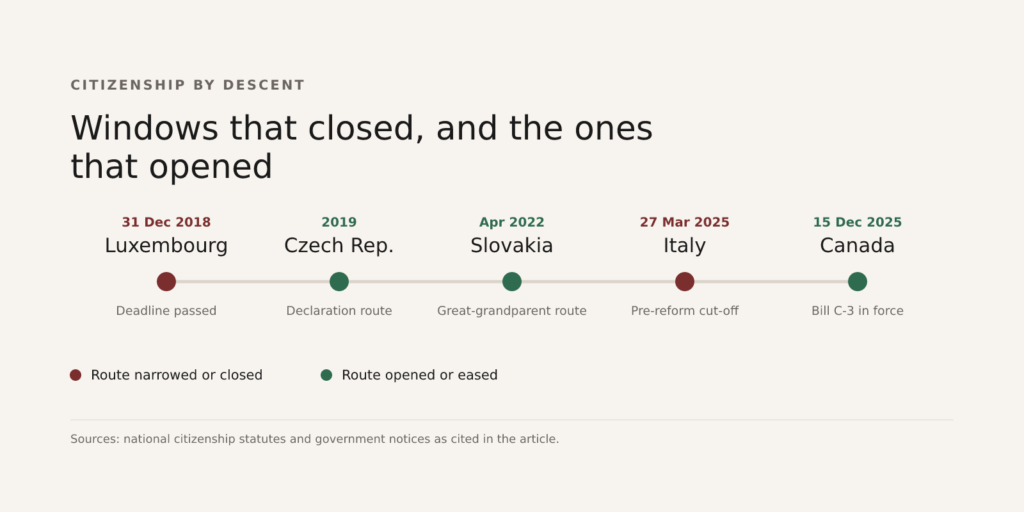
The Czech Republic moved the other way. Since 2019 the citizenship act has allowed children and grandchildren of former Czech or Czechoslovak citizens to acquire citizenship by declaration rather than by application, which is a materially lighter process.
Luxembourg went the opposite direction and shut. Reclaiming Luxembourgish nationality through an ancestor who held it on 1 January 1900 required a certificate of descent requested from the Ministry of Justice by 31 December 2018. Nobody who missed that date can use the route now. Canada reopened one: after the Ontario Superior Court struck down the first-generation limit in Bjorkquist in 2023, Bill C-3 received royal assent on 20 November 2025 and came into force on 15 December, replacing the limit with a substantial-connection test of 1,095 days spent in Canada.
Watching six or seven jurisdictions at once is the part clients underestimate. A family that would have qualified in Italy in February 2025 and did nothing about it no longer qualifies, and no amount of research recovers that.
What she is building next
Alongside the European casework, Wayne is developing methods for lineages where the paper trail was never kept in the first place, particularly across the African diaspora, an area with no established playbook and very little formal record to work from.
Writing about her own approach, she put it this way: “If you don’t see a path already built for the work you want to do, build it yourself, and if you do see one, make it better.” Being one of the few Black women working in a field shaped by a narrow set of voices, she says, is what made that gap visible to her before it was visible to the industry.
About Your Ancestral Path
Your Ancestral Path is an independent citizenship-by-descent and genealogical research practice founded by Shantonia Wayne, offering eligibility assessments, document sourcing and end-to-end case preparation across more than a dozen jurisdictions. More at yourancestralpath.com and on LinkedIn.
About Post Author

You may also like
-
The European Union’s Path to Less Packaging Waste
-
How Commercial Roof Maintenance Can Improve Property Management
-
The statistic behind every future-of-work speech deserves a closer look
-
Leigh Tesar Scheme Allegedly Targeted Terminally Ill Patients with High-Payout Wound Procedures
-
How to Bring Your Spouse to the United States
