
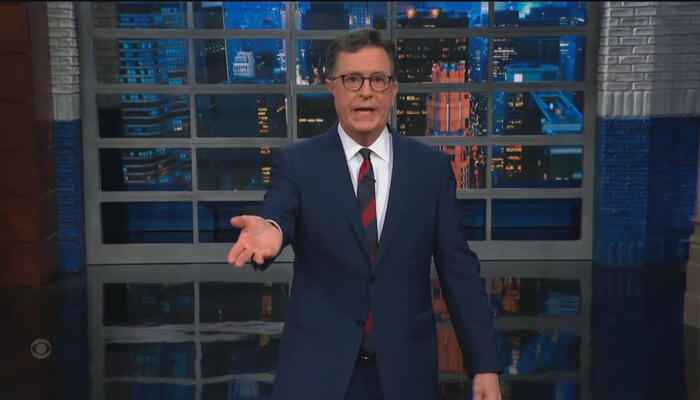
Stephen Colbert tried Cancel Culture in an early form back 2014.
Colbert, then hosting Comedy Central’s The Colbert Report, uttered stereotypically Asian gibberish to mock Washington Redskins’ owner Daniel Snyder’s alleged insensitivies.
The tweet was translated into Twitter without providing the context. A #CancelColbert hashtag campaign blossomed. Colbert’s response? Colbert used his fake conservative persona to ignore the controversy.
It worked.
There are no excuses. No promises to be an “ally” to the Asian-American community. This happened in 2014, a time when woke Apology Tours weren’t yet a thing.
Fast forward to 2021 and Colbert’s view on Cancel Culture is very different. He jokes it doesn’t actually exist, for starters, ignoring the mountains of evidence to the contrary.
Colbert was cautious to open up about this subject in a Crooked Media interview.
Colbert is quick-witted and a good talker, but Colbert was careful with his choices during the Cancel Culture portion of the conversation. It’s almost like he knew saying the wrong thing might get him canceled.
Colbert said that when it came to comedy, he worked once under a simple principle.
“I can control my intentions but not your interpretations. That said,” he explained, allowing himself a very long pause, “I also value humility. And that’s something that I haven’t always associated with my work.”
Translation. There might be some problematic jokes from my past. Here’s my de facto apology.
The Late ShowThe host stated that the old was being used Colbert Report persona, the hard-charging conservative in the Bill O’Reilly mold, let him indulge in appetites he no longer applies to his craft.
“I wanna be able to say anything I want about anything, and I think that you should have the ability to say anything you want about anything,” he said of his thinking then, and now (sort of). “That doesn’t mean you get the response you want … there are consequences.”
“What does Cancel Culture mean? Somebody didn’t like [the joke], they got a lot of people to agree that they didn’t like it, and now you have to deal with their feelings. What do you think? It’s a real thing,” he said, ignoring how it’s often microscopic mobs who trigger the cancellations.
“And if Cancel Culture really existed why is Mel Gibson working? Why?” Colbert quipped.
Colbert is forgetting that Gibson, who unleashed an array of antisemitic slurs in a 2006 incident with the police, became Hollywood’s radioactive. In reality, he retreated from the A-list and his IMDB profile is blank from 2006 to 2009. Indie movies like “The Last of Us” were his most frequent return to prominence. Gringo(2012) Blood Father(2016). He proved he was trustworthy on film sets.
He seemed contrite, treated colleagues well and, eventually, scored a more mainstream gig – directing the Oscar-nominated 2016 film Hacksaw Ridge.
Now, having paid a steep price for his ugly outbursts, he’s been allowed back into Hollywood’s good graces. There are many projects in his future, including acting as director and star. Lethal Weapon 5.
It’s called forgiveness, and while some may never forgive Gibson for what he’s said and done, others agreed he should be allowed to create new art.
Cancel Culture, by comparison, often involves more conventional words which don’t inflict physical pain, just bruised feelings. Gibson’s verbiage, by comparison, was extremely offensive from every possible angle.
Colbert agreed then with Cancel Culture’s ethos that comics should be treated as serious individuals, like politicians.
“I never hide behind, ‘it’s just a joke,’” he said. “It’s a joke, and those are hard. Try to do them thoughtfully.”
Like calling a sitting president Vladimir Putin’s “c*** holster?”
Colbert overlooks the fact that comedians often work on-the-spot. Colbert forgets that comedians often create new jokes and tweak existing ones, constantly improving their humor. One bad joke might turn out to be a great one a few days later.
Comics have to be able to work on their material without worrying about being cancelled. This is often when the most original humor comes out.
Does he think Dave Chappelle’s best material happened overnight? Every comic tells stories about being bombed early on in their career. Here’s betting the jokes in question were terrible and needed some workshopping.
Colbert also danced a lot in the interview.
“If I have someplace to stand, where I think it has an overt meaning, then there’s no joke I feel uncomfortable saying,” he said.
Wait, there are exceptions.
“I have come to believe that saying to historically marginalized people…‘y’all gotta take a joke,’ is a little Olympian,” he said. “You can say it, but I think it might be…a little solipsistic to think your intention is a more important than the effect of your work.”
He’s pro Cancel Culture (even if he wonders if it exists). He’s in curious company here, though.
Who determines what groups belong in which category? Is it a rule that these groups can’t be ridiculed in any manner, whether playfully or not? Are there any rules for play? Is Hollywood conservatives considered an excluded group?
If you don’t, then why not?
What about those who take offense to almost everything? Are we to cancel comics that trigger these reactions?
Colbert apparently wants both. He’s also thinking he’s safe from the Cancel Culture mob. Five nights per week, he presents progressive talks on CBS. This, he claims, gives him protection against the woke mob.
He’s right…to a point.
Up until last year, Dave Chappelle was a favorite of the Left. The Left loved J.K. Rowling until last year. The two of them departed from the progressive model, though only briefly. Now, they are constantly attacked by the press, as well as woke warriors.
Colbert could also be affected.
[Cross-posted from Hollywood in Toto]
About Post Author

You may also like
-
How Commercial Roof Maintenance Can Improve Property Management
-
The Untraceable Isn’t Unprovable: Shantonia Wayne on the Paper Trail Behind Citizenship by Descent
-
The statistic behind every future-of-work speech deserves a closer look
-
Leigh Tesar Scheme Allegedly Targeted Terminally Ill Patients with High-Payout Wound Procedures
-
How to Bring Your Spouse to the United States
