
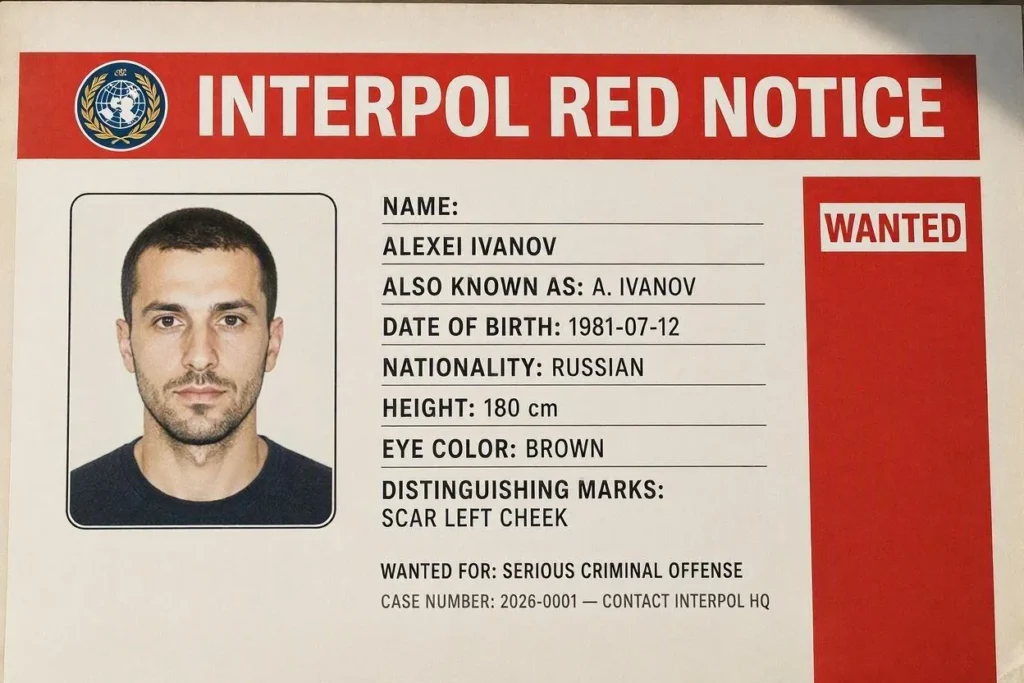
What “provisional arrest” means in extradition narratives and what to watch for in court.
WASHINGTON, DC, September 7, 2026 — References to provisional arrest frequently appear between an Interpol Red Notice and an extradition hearing, but the phrase describes temporary custody under national law rather than a final ruling that the accused must be surrendered to another government.
For readers following United States extradition cases, understanding that distinction clarifies why an arrest may occur before complete diplomatic papers arrive, why courts monitor treaty deadlines and why a person can remain in litigation months or years after the first police encounter.
It also prevents confusion among three separate instruments: the originating arrest warrant supports the criminal accusation, the Red Notice circulates an international lookout, and the provisional arrest order authorizes temporary custody in the country where the person is found.
The formal extradition request comes later or accompanies the arrest application, presenting the treaty-based case that a court and, in many systems, an executive authority must evaluate before any lawful international transfer can occur.
Due process therefore begins well before the ultimate hearing, starting with lawful arrest authority, notice of the grounds for detention, access to counsel, and prompt judicial review rather than waiting until officials have already approved surrender.
First, determine which direction the case is moving
United States extradition coverage can describe either American prosecutors seeking the return of a defendant located abroad or a foreign government asking United States authorities to surrender someone found within American territory, and the procedures are not interchangeable.
In an outbound case, a federal or state charging document and domestic warrant may support a Red Notice, after which foreign police locate the accused and apply their own law when deciding whether the notice or a separate request authorizes provisional detention.
In an inbound case, a foreign Red Notice may alert American authorities to a person’s location, but United States guidance states that the notice alone does not provide sufficient national authority to make an extradition arrest.
The foreign government must use the applicable treaty route, generally sending a provisional arrest request or a completed extradition package through diplomatic channels or directly between designated central authorities when a modern treaty expressly permits that method.
American readers should consequently ask who issued the underlying warrant, which country physically holds the person, and which government is requesting surrender, because those answers identify the controlling treaty, court system, filing rules, and available remedies.
The basic relationship between a Red Notice and extradition remains consistent in either direction, since the alert helps identify and locate the wanted person while national institutions decide whether detention and eventual transfer satisfy independent legal requirements.
What triggers provisional arrest
Provisional arrest exists because preparing a formal extradition request can take weeks, particularly when prosecutors must assemble certified warrants, charging records, affidavits, statutory provisions, identifying evidence, limitation-period analysis, official authentications and translations acceptable to the requested country.
If authorities learn that a wanted person is changing hotels, booking international travel or otherwise likely to leave, waiting for the completed package could defeat extradition before the requested government receives enough material to begin its ordinary proceedings.
Most United States treaties therefore permit an emergency request that identifies the person, describes the offense, confirms the warrant, explains the urgency, and promises delivery of supporting documents within a specified period after arrest.
The Justice Department’s international extradition manual assigns requests involving American prosecutions to the Office of International Affairs, which determines treaty compliance and prevents individual agents or prosecutors from seeking foreign arrests through unauthorized informal contacts.
For foreign requests directed at someone inside the United States, the State Department and Office of International Affairs examine treaty coverage before an assigned federal prosecutor seeks a complaint and judicial warrant for provisional arrest in the appropriate district.
That additional domestic warrant matters because Interpol is an information-sharing organization rather than a supranational police force, and neither its Lyon headquarters nor the requesting country can unilaterally exercise arrest powers inside the United States.
When urgency is absent, officials may submit the full extradition package before seeking custody, allowing a court to issue an arrest warrant with the supporting materials already available and avoiding the compressed timetable that follows provisional detention.
What the first docket entries may reveal
An extradition docket involving provisional arrest may begin with a sealed complaint, government application, supporting declaration and arrest warrant, followed after execution by an initial appearance, appointment or appearance of counsel, detention arguments and scheduling orders.
The complaint should identify the requesting country, relevant treaty, foreign warrant, alleged offenses and basis for believing the person before the court is the individual sought, although sensitive supporting material may initially remain sealed or restricted.
At the first appearance, the judge generally explains why the person was arrested and addresses representation, custody and future proceedings, while counsel begins examining whether officials complied with treaty transmission rules and domestic statutory authority.
Identity can become an immediate issue when names are common, transliterations vary or the notice contains outdated biographical details, making fingerprints, photographs, passport records and witness evidence important before the court ever considers the substance of extraditability.
The judge may set a status conference near the treaty deadline, direct prosecutors to report when formal papers arrive, and establish a briefing schedule that allows defense review without letting temporary detention continue indefinitely on an emergency promise.
Journalists should distinguish an initial appearance from an arraignment in the foreign criminal case, because the requested country’s court is supervising extradition rather than asking the person to plead guilty or not guilty to charges pending overseas.
The treaty deadline is the first major clock
Once provisional custody begins, the requesting government must submit its authenticated extradition package within the period specified by the treaty, which Justice Department guidance describes as ranging from approximately 30 days to three months across different agreements.
The exact calculation can depend upon treaty language, the arrest date, transmission rules, weekends, official receipt, and extensions expressly allowed by domestic law, making the controlling text and court orders more reliable than generalized descriptions in news reports.
Formal papers commonly include the warrant and charging document, factual affidavits, evidence establishing identity, relevant criminal statutes, maximum penalties, limitation provisions, and certifications confirming that records come from competent authorities in the requesting state.
Translations can become a practical bottleneck in outbound American cases, while certifications, diplomatic notes and inconsistencies involving names or dates can require correction before the package is transmitted to the foreign ministry and then forwarded to the responsible court.
If the deadline passes without sufficient papers, the person may be entitled to release from provisional detention, although that result ordinarily does not cancel the Red Notice, invalidate the foreign warrant or prevent later proceedings based upon a completed request.
Readers should therefore avoid describing deadline-based release as exoneration, while also recognizing that enforcing the deadline is a substantive liberty protection preventing governments from holding people indefinitely before producing the legal case promised at arrest.
Bail litigation tests the meaning of temporary custody
Provisional arrest often produces an immediate dispute over detention because the government emphasizes flight risk inherent in international proceedings, while the defense argues that strict release conditions can protect the process without converting an allegation into prolonged punishment.
United States extradition jurisprudence traditionally treats bail more restrictively than ordinary federal criminal cases, generally requiring special circumstances alongside confidence that the person will not flee, although courts evaluate the particular record and controlling precedent in each district.
Potential conditions can include secured bonds, property pledges, responsible custodians, electronic monitoring, home confinement, passport surrender, travel restrictions and regular reporting, yet substantial wealth or multiple nationalities may strengthen rather than reduce governmental flight concerns.
Defense submissions may emphasize serious health needs, unusual delay, strong community ties, prior voluntary appearances or exceptional legal issues, while prosecutors commonly cite treaty obligations and the diplomatic consequences of losing someone whom another government formally requested.
A detention ruling is not an extradition ruling, so a judge can deny bail while later rejecting surrender, or permit monitored release while ultimately certifying extraditability after reviewing the complete foreign evidentiary package.
Court watchers should examine whether custody findings rely upon individualized evidence or merely repeat the existence of a Red Notice, because the alert communicates foreign interest but does not independently establish flight, danger, or the legal sufficiency of extradition.
The formal hearing has a limited purpose
After authenticated documents arrive, the court schedules an extradition hearing to determine whether the treaty and federal statute authorize certification, rather than holding a full trial on guilt or resolving every factual dispute in the underlying prosecution.
The judge generally considers jurisdiction, identity, treaty validity, whether the alleged conduct qualifies as extraditable, and whether the submitted evidence satisfies the applicable standard, which frequently resembles probable cause rather than proof beyond a reasonable doubt.
Dual criminality asks whether the essential conduct would be criminal in both countries, without necessarily requiring identical offense titles, while treaty provisions may exclude political offenses, time-barred charges, prior adjudications, or conduct below a stated punishment threshold.
The federal rules governing criminal trials and ordinary evidence do not apply in the same manner during United States extradition hearings, and defense evidence may be limited when it contradicts the requesting government’s proof rather than explaining or negating its probable-cause showing.
Those procedural limits make the distinction between extradition and prosecution essential, because certification only establishes that legal conditions permit surrender and does not determine whether the person committed the charged acts or should ultimately be convicted.
Humanitarian claims involving torture, persecution, anticipated punishment, or medical vulnerability may intersect with judicial issues, but some arguments are reserved principally for the Secretary of State’s later executive review rather than resolved completely by the extradition judge.
Certification is not the final handover order
If a United States judge finds the person extraditable, the court certifies the record to the Secretary of State, whose office makes the ultimate executive determination whether surrender should occur and may consider foreign policy or humanitarian information beyond the judicial inquiry.
The certification itself is generally not reviewed through an ordinary direct appeal, but the person may file a petition for habeas corpus, and any resulting district court decision can be appealed while counsel may request a stay preventing transfer during review.
Habeas review is narrower than a new extradition hearing, ordinarily examining whether the magistrate had jurisdiction, whether the offense fell within the treaty, and whether competent evidence supported the certification rather than retrying the requesting country’s criminal case.
The docket may therefore show a separate civil habeas action, emergency stay motions, appellate notices, and executive correspondence after the extradition court has completed its work, explaining why an approved certification does not always produce immediate surrender.
If the Secretary issues a surrender warrant after judicial review concludes, the Office of International Affairs coordinates with the requesting government and law enforcement personnel to arrange custody transfer within any additional period prescribed by treaty or statute.
Conversely, the executive branch can decline surrender even after judicial certification, illustrating the deliberately divided structure through which courts decide legal extraditability while the political branch retains responsibility for the final international handover.
Outbound American cases follow foreign procedure
When the United States requests a defendant from abroad, American prosecutors prepare the case through the Office of International Affairs and the State Department, but the foreign jurisdiction controls provisional arrest, bail, hearings, appeals, and the ultimate legal authorization for departure.
A foreign court may approve some American charges while rejecting others under dual criminality or treaty provisions, creating specialty limitations that generally prevent prosecution after surrender for counts outside the scope approved by the requested country.
Long-running disputes can involve multiple appeals, constitutional litigation, and diplomatic assurances, as reflected in the extended Kim Dotcom extradition history described by Amicus International, which shows how far a case can go beyond the first arrest.
At the opposite extreme, consent or waiver can compress the timetable dramatically because the arrested person chooses not to demand a full extradition determination, although counsel must ensure that any waiver is informed, voluntary, and properly documented.
When FTX founder Sam Bankman-Fried decided to accept return from the Bahamas, Reuters reported the shifting court proceedings surrounding his extradition consent, illustrating how waiver decisions can change an expected litigation schedule within days.
Each example remains fact-specific, and an expedited transfer should not be interpreted as an admission to the criminal allegations, just as extended litigation does not establish innocence or prove that the requesting prosecution is improper.
The timeline entries worth watching
A reliable chronology should identify the original complaint or indictment, domestic arrest warrant, Red Notice publication or circulation, location event, provisional arrest request, arrest date, first judicial appearance, and exact deadline for the formal extradition package.
The next entries should record receipt and authentication of supporting documents, detention or bail rulings, briefing deadlines, extradition hearing dates, certification or denial, habeas proceedings, stays, executive review and the eventual surrender, release or alternative disposition.
Reporters should attribute allegations to charging authorities, state whether the person has been convicted or merely accused, and avoid calling the Red Notice an international warrant, because each shortcut obscures a different safeguard within the process.
They should also distinguish release from deletion, since a court may end provisional custody while Interpol data remains active, and Interpol may remove a notice while an independent national arrest order or completed extradition request continues supporting proceedings.
Case timelines can pause because translations are unfinished, evidence requires certification, another domestic prosecution takes priority, health issues delay hearings, appeals remain pending, or diplomatic assurances need negotiation, none of which necessarily predicts the final outcome.
Due process starts when liberty is restrained
The most important principle is that provisional arrest does not create a law-free waiting room between international policing and extradition, because every day of custody requires domestic authority, treaty compliance and access to a court capable of reviewing continued detention.
For the requesting government, urgency creates an obligation to produce accurate formal papers quickly; for the detained person, it creates an immediate need to verify identity, preserve filing deadlines, seek counsel and separate Interpol challenges from national extradition defenses.
For courts, the task is to protect international cooperation without treating a foreign accusation as a judgment, ensuring that temporary detention remains proportionate and that surrender occurs only after the institutions assigned legal and executive responsibility complete their respective reviews.
Reading the docket through those distinctions reveals what provisional arrest actually means: a closely supervised opening stage that preserves the possibility of extradition while leaving the ultimate criminal allegations, treaty determination, and surrender decision unresolved.
About Post Author

You may also like
-
International Fugitive Brian Nelson Booker Faces Federal Charges in Offshore Tax Case
-
Walter Presha Jr. Released on Bond After Indictment Accused Him of Steering Medicare Patients to Leigh Tesar
-
Why Drug Weight Matters in a Trafficking Case in Monroe, Georgia
-
How White-Collar Crime Investigations Develop in Atlanta, Georgia
-
When Does a Negative Online Review Become Defamation?
